

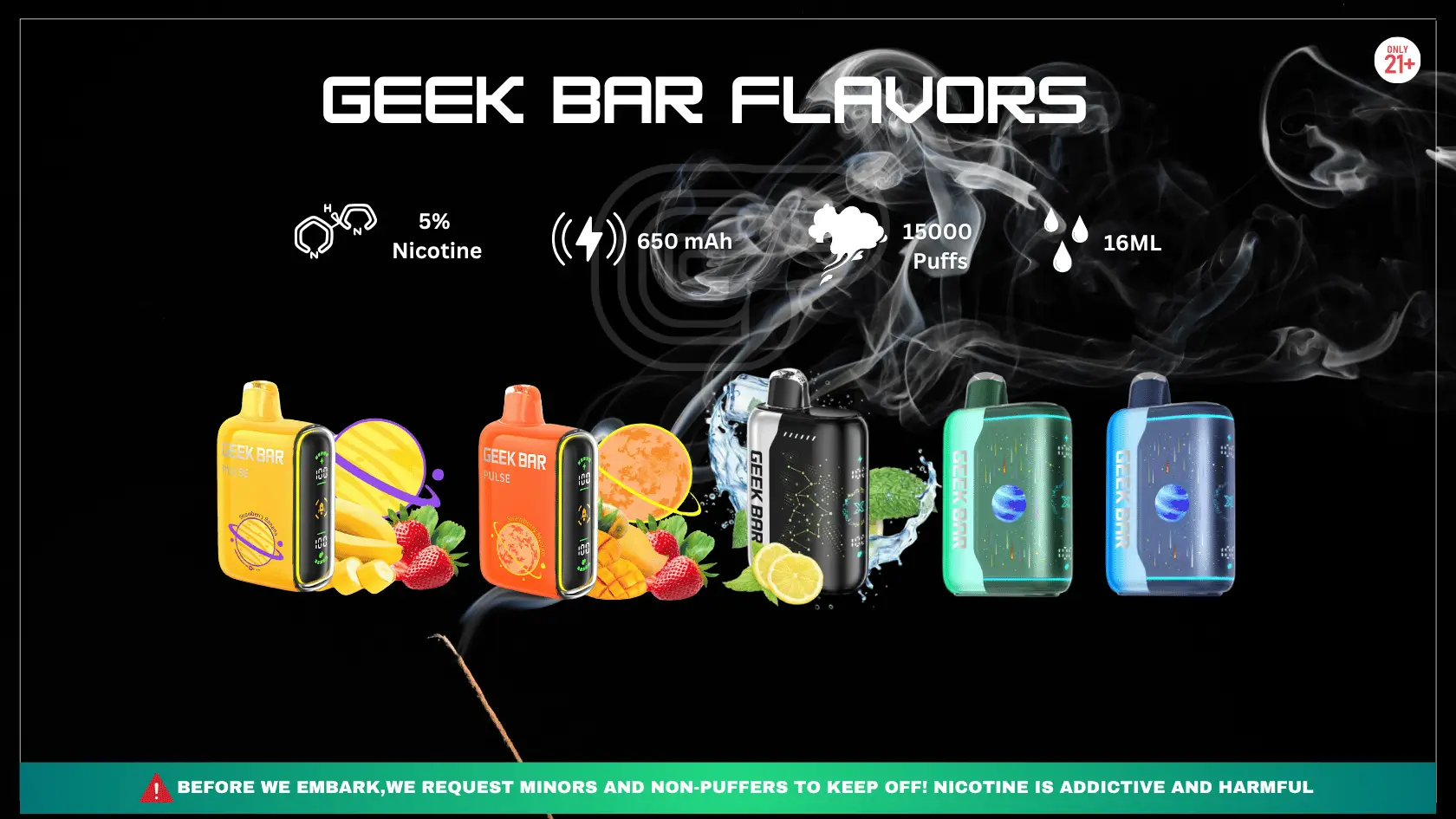
If you’ve spent any time comparing high-capacity disposables in 2026, you’ve probably noticed one brand keeps showing up in every “top disposable” list: Geek Bar. But “Geek Bar” isn’t one device anymore — it’s a whole family, and the differences between models (and between Geek Bar and its closest rivals) matter a lot more than most buying guides let on. This guide breaks down where Geek Bar Pulse devices actually beat the competition, how the lineup has changed, and which model is worth your money if you’re ready to buy Geek Bar online today.
We’ll walk through the evolution of the lineup, a full spec-by-spec comparison of the three most-searched Pulse devices, charging and usage guidance, real market and regulatory context, and answers to the questions we see most often from first-time buyers.
This isn’t a marketing rundown — it’s the same kind of comparison we’d want to read before spending our own money. Where a spec sounds impressive but doesn’t matter much in daily use, we’ll say so. Where one device genuinely beats a rival, we’ll explain exactly why, using real specs and sourced data rather than vague claims.
📋 Table of Contents
Geek Bar Pulse devices stand out mainly because of three things rivals still struggle to match consistently: dual-mesh coil performance, dual-mode puff output, and a live display screen instead of a blinking light. That combination is rare at this price point.
Most disposable brands rely on a single mesh coil and one fixed puff count. Geek Bar’s Pulse platform instead gives you two modes — a standard mode built for maximum puff count, and a “Pulse” mode that trades some total puffs for stronger airflow and a denser hit. That flexibility is a big reason the brand keeps beating newer competitors in independent reviews and community threads.
If you’re new to the brand entirely, our Geek Bar guide covers the full lineup, terminology, and how the different device families relate to each other before you dive into a head-to-head comparison.
There’s also a practical reliability factor. Dual-mesh coils distribute heat more evenly across a larger surface area than a single mesh element, which tends to reduce the burnt or muted-flavor issue that shows up late in a disposable’s life. Rivals that stuck with single-coil designs into 2026 are increasingly the exception rather than the norm, largely because buyers noticed the difference and started comparing before purchasing.
None of this means every Geek Bar device is automatically better than every competitor on every spec. Some rival brands match or beat Geek Bar on raw puff count alone. Where Geek Bar tends to win is the combination of coil quality, mode flexibility, and display accuracy together — not any single spec in isolation.
Geek Bar has moved from simple, single-mesh disposables in 2022 to AI-assisted, dual-mode, screen-equipped devices by 2026. Each generation added either more puffs, better coil tech, or smarter airflow control — rarely just one at a time.
Early Geek Bar models focused on simplicity: single coil, fixed puff count, no screen. As competition in the disposable space intensified, the brand shifted toward rechargeable batteries, larger e-liquid tanks, and dual-coil setups to extend device life and improve flavor consistency late in the tank.
By the Pulse generation, Geek Bar had added dual-mesh coils and dual-mode puff counts. The X and X2 generations pushed further with curved LED displays and AI-based power adjustment that reads your draw and adjusts wattage in real time. For the full device-by-device timeline, our Geek Bar evolution breakdown covers every release since 2022 in order.
The core difference between Geek Bar Pulse and Pulse X comes down to tank size, coil setup, and smart features. Pulse X carries a larger e-liquid capacity, a curved LED display, and AI-based airflow adjustment that the original Pulse doesn’t have.
The original Pulse established the dual-mesh coil and dual-mode format that made the brand popular. Pulse X kept that foundation but scaled up the tank size and added the 3D curved LED screen for live battery and e-liquid tracking, along with AI Power Adjustment for more consistent draws across a session.
In day-to-day use, that means Pulse X tends to run longer between disposals and gives more visibility into how much life is left in the device. If you want a full side-by-side spec breakdown beyond what’s covered here, check our dedicated Geek Bar Pulse vs Pulse X comparison guide.
The Geek Bar Pulse X2 builds on the X generation with a refined coil design, an even larger e-liquid tank in most flavor releases, and tighter AI airflow calibration for a more consistent throat hit from the first puff to the last.
Where the original Geek Bar Pulse X introduced smart features, the X2 generation focuses on refining them — smoother mode switching, more accurate battery readouts on the display, and coil improvements aimed at reducing the flavor drop-off that tends to happen late in a disposable’s life.
Battery consistency is also a bigger focus in the X2 generation. Earlier disposables often showed a sharp drop in vapor quality once battery levels fell low, since airflow and wattage weren’t adjusted dynamically. The X2’s tighter AI calibration is built specifically to smooth that curve out, so the last quarter of the tank doesn’t taste noticeably weaker than the first.
For full specs, flavor lineup, and setup details, see the dedicated Geek Bar Pulse X2 device page.
Here’s how the three most-searched Geek Bar Pulse devices stack up against each other, spec for spec:
| Spec | Geek Bar Pulse | Geek Bar Pulse X | Geek Bar Pulse X2 |
|---|---|---|---|
| Puff Count | Up to 25,000 | Regular: 25K / Pulse: 15K | Regular: 25K+ / Pulse: 15K+ |
| E-liquid Capacity | 16.0 mL | 18.0 mL | 18.0+ mL |
| Heating Element | Dual-Mesh Coil | Dual-Mesh Coil | Refined Dual-Mesh Coil |
| Display | LED Indicator Light | 3D Curved LED Screen | Enhanced Curved LED Screen |
| Airflow | Fixed Airflow | AI Power Adjustment | Tighter AI Calibration |
| Charging | USB-C, Rechargeable | USB-C, Rechargeable | USB-C, Fast Charging |
The pattern across generations is consistent: each new release keeps the dual-mesh, dual-mode foundation and adds incremental improvements to tank size, screen accuracy, or airflow calibration rather than reinventing the device from scratch.
The disposable vape category has grown into a multi-billion-dollar global market, and that scale is exactly why spec differences between brands (and between generations of the same brand) matter more than they used to. More competition means more pressure to actually improve hardware, not just repackage it.
Grand View Research estimates the global e-cigarette and vape market reached roughly $45.7 billion in 2025 and is on track to grow to around $59 billion in 2026, with North America accounting for the largest regional share. That kind of growth is exactly why device competition has accelerated — bigger tanks, dual coils, and smarter airflow didn’t happen by accident. Flat, single-coil disposables stopped being competitive once buyers had faster-improving alternatives.
Regulation has tightened alongside that growth. As of early 2026, the FDA had authorized only a small number of e-cigarette products for legal U.S. marketing — all tobacco or menthol flavored — which means most flavored disposables on shelves, across every brand, technically sit outside formal FDA marketing authorization even where they remain available at retail. That’s part of why buying from verified, age-gated retailers matters more than it used to, rather than relying on unverified marketplace listings.
On the youth-access side, the CDC’s 2025 National Youth Tobacco Survey found e-cigarette use among U.S. middle and high schoolers had actually declined slightly year over year, continuing a downward trend tied largely to stricter retail age-verification enforcement. It’s a big part of why every legitimate Geek Bar retailer — including ours — enforces a 21+ purchase age with ID checks at checkout.
You charge the Geek Bar Pulse X2 through its USB-C port, and it’s designed to be topped up repeatedly throughout the e-liquid’s life rather than charged once and thrown away after a single session.
A full charge before first use is recommended to establish accurate battery readings on the display. After that, most users charge it whenever the screen shows a low-battery indicator rather than running it down completely each time.
For step-by-step charging instructions, including troubleshooting for slow charges or display issues, see our full Geek Bar Pulse X2 charging guide.
Using any Geek Bar Pulse device correctly starts with a full initial charge, followed by picking your mode (Regular or Pulse) and simply inhaling — there’s no button, since the device is draw-activated.
Beyond that, checking the display before long sessions helps you avoid running the battery flat mid-use, and switching modes based on whether you want more total puffs or a stronger hit per pull makes a real difference in how the device performs over its lifespan.
If you’re setting one up for the first time, our full how to use Geek Bar Pulse guide walks through charging, mode switching, and common first-time mistakes in more detail. It’s also worth checking independent Geek Bar review threads and forums before buying, since real-world usage patterns often reveal quirks that spec sheets don’t.
If you want the simplest, most affordable entry point, the original Pulse is still solid. If you want a bigger tank and a live display, Pulse X is the better pick. If you want the most refined coil and airflow performance currently available, Pulse X2 is the strongest option in the lineup.
None of the three are a bad choice — the “right” one really depends on how much you value screen accuracy and airflow consistency versus a lower price point. All three share the same dual-mesh, dual-mode foundation that separates Geek Bar from most single-coil rivals on the market.
A quick way to decide: if you’re buying your first high-capacity disposable and want to keep things simple, start with the original Pulse. If you’ve already tried a Pulse and want more tank life plus real-time tracking, move up to Pulse X. If you’re comparing top-tier disposables across brands and want the sharpest performance Geek Bar currently offers, Pulse X2 is the one to put head-to-head against any rival’s flagship device.
Whichever model fits your needs, buying through a verified retailer matters as much as the device spec sheet does. Given how much of the flavored disposable market currently sits outside formal FDA marketing authorization industry-wide, sticking with age-gated, verified sellers is the simplest way to avoid counterfeit or unauthorized stock.
Pulse established the dual-mesh, dual-mode format. Pulse X added a larger tank and a curved LED display with AI airflow. Pulse X2 refines the coil and airflow calibration further while keeping the same core design.
Yes. Pulse, Pulse X, and Pulse X2 all charge via USB-C and are designed to be topped up repeatedly until the e-liquid runs out.
Ratings range up to 25,000 puffs in Regular Mode across the Pulse line, with Pulse Mode typically rated closer to 15,000 in exchange for stronger airflow. Actual results vary based on draw length and frequency.
Compared to most single-coil disposables from competing brands, yes — the dual-mesh coil, larger tank, and AI airflow calibration typically translate to more consistent flavor and vapor output over the device’s full lifespan.
In the U.S., federal law sets the minimum purchase age for any vapor product, including Geek Bar Pulse devices, at 21. Many states and individual retailers apply additional ID checks on top of that.
Geek Bar Pulse — Disposable Vape
🛒 Where to Buy Online
Choose from our verified partner stores — all carry 100% authentic Geek Bar Pulse products sourced directly from official US distributors.


Twelve Tribes
Wide Selection • Best Prices


Raven Route
Fast Delivery • All Flavors


Zippyzz
Quick Shipping • Great Deals
🔒 All partner stores are verified, age-gated, and ship only to legal US states. Purchases are made directly with the retailer — not geekbarpulse.com.
⚠️ Must be 21+ to purchase.