

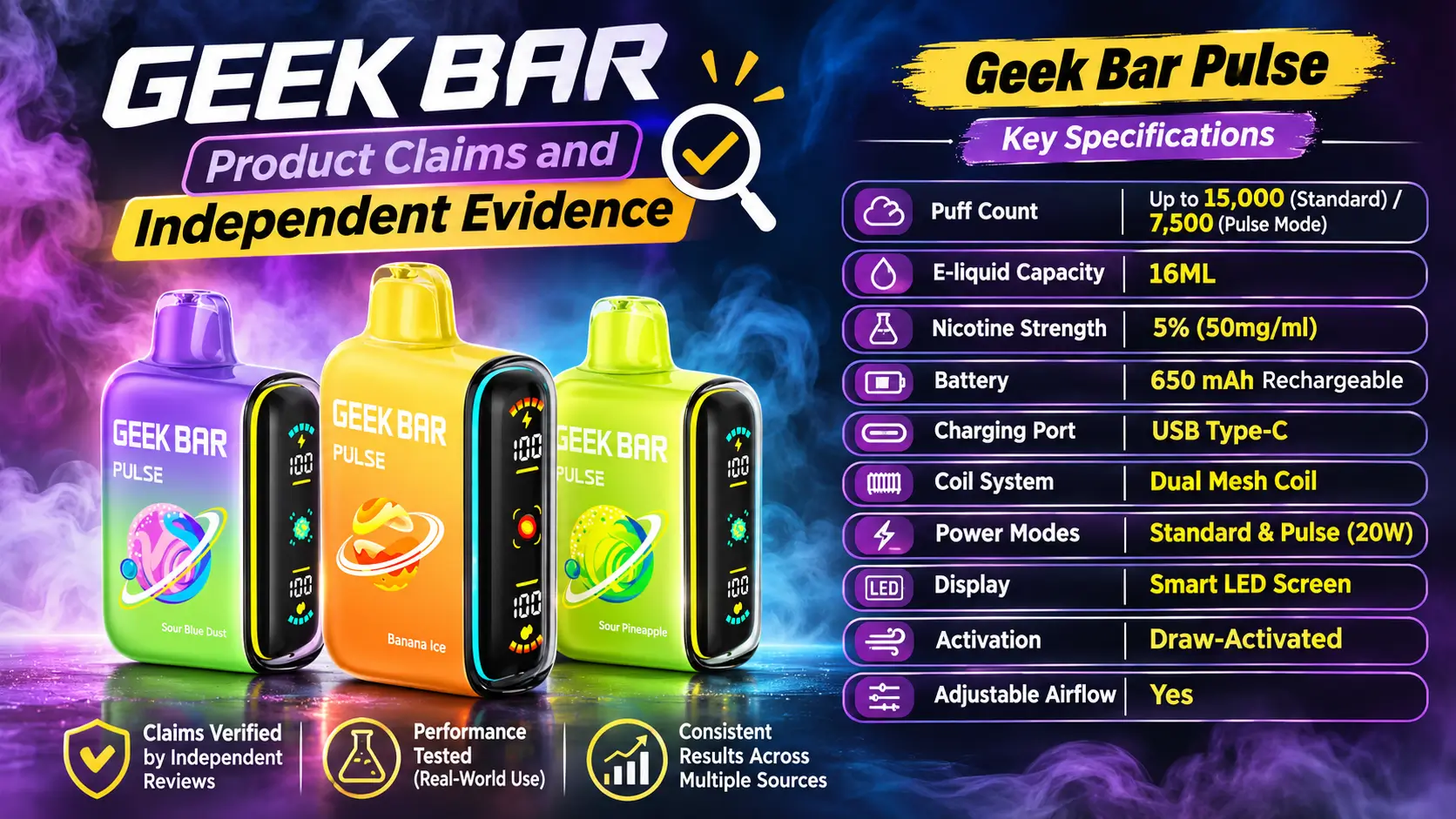
Geek Bar Product Claims cover every number on the package: 16 mL of e-liquid, a 650 mAh battery, up to 15,000 puffs, and 5% nicotine. This guide shows you which of those numbers you can check yourself on a Geek Bar and which ones need independent evidence.
Some claims take a USB-C cable and ten seconds to confirm. Others need lab equipment. You will learn the difference, plus a simple scorecard for comparing devices without getting dazzled by a big number.
📋 Table of Contents
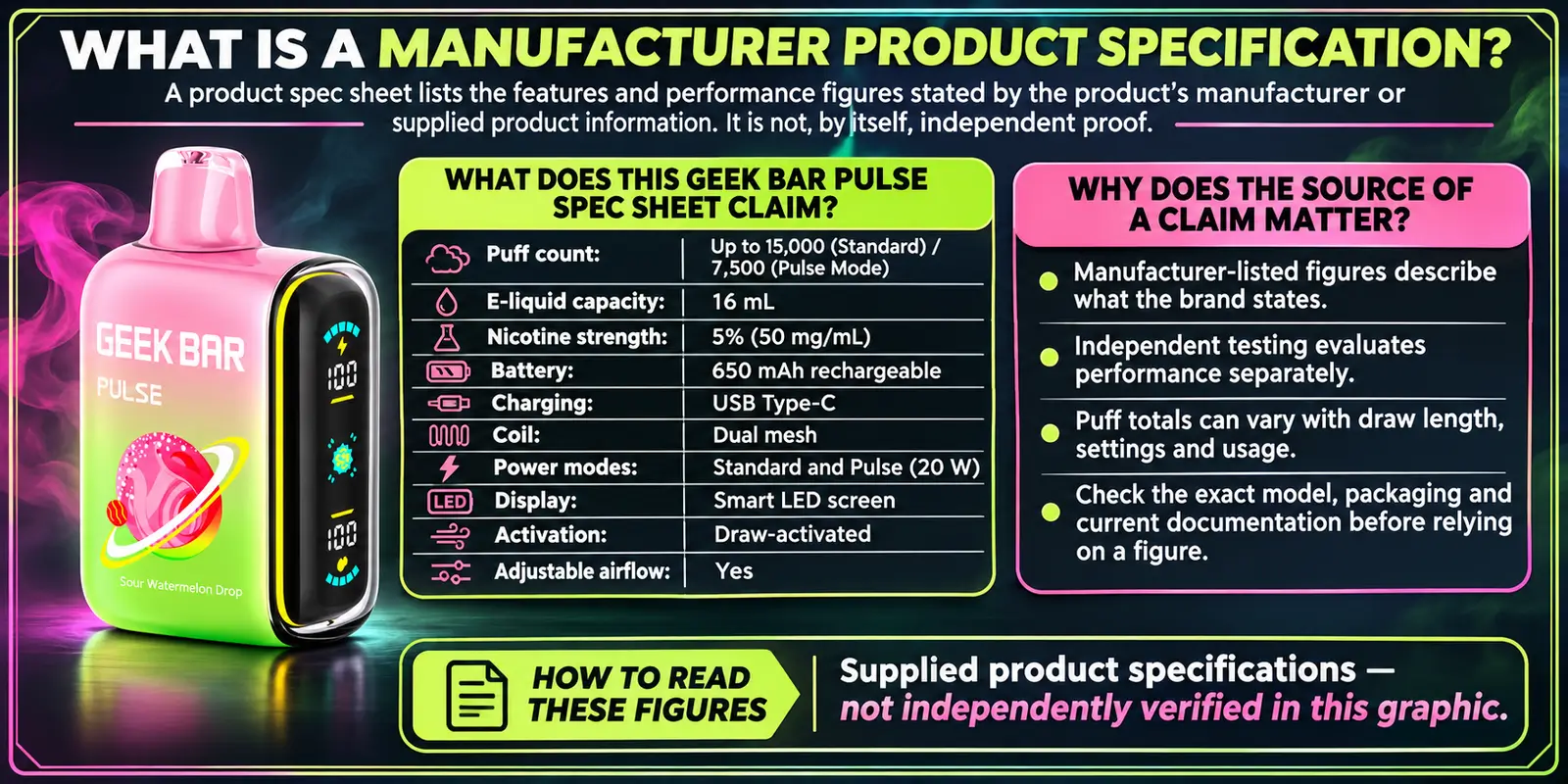
A manufacturer product specification is a figure or feature the brand publishes about its own device. It comes from the company, not from an outside lab. That makes it a fair starting point and a weak form of proof.
Think of a spec sheet as a résumé. It tells you what the brand wants you to know, and it is usually accurate on the easy items. The harder items, like lifespan and nicotine content, need a reference check.
These are the claims we evaluate throughout this guide:
| Spec | Details |
|---|---|
| Prefilled Capacity | 16 mL |
| Battery Capacity | 650 mAh |
| Charging Port | USB Type-C |
| Operation | Draw-Activation |
| Regular Mode Max Puffs | 15,000 |
| Pulse Mode Max Puffs | 7,500 |
| Nicotine | 5% |
Three of these claims are easy to confirm. You can read the capacity on the label, plug a USB Type-C cable into the port, and test draw activation by inhaling. The two puff counts and the 5% nicotine figure are different. Those need measurement.
A claim backed by a third party carries more weight than a claim repeated by every retailer. Many listings copy the same numbers word for word. Repetition feels like confirmation, but it only multiplies one source.
One label statement does come from regulation. Federal rules require this warning on nicotine products: “WARNING: This product contains nicotine. Nicotine is an addictive chemical.” (21 CFR 1143.3). Puff count and battery size carry no such mandate.
Regulatory note: The FDA has stated that Geek Bar products are not authorized for sale in the U.S., and it has sent warning letters to retailers that name Geek Bar Pulse. No federal reviewer has checked the printed figures, so independent evidence matters even more. Federal law sets the minimum purchase age at 21.
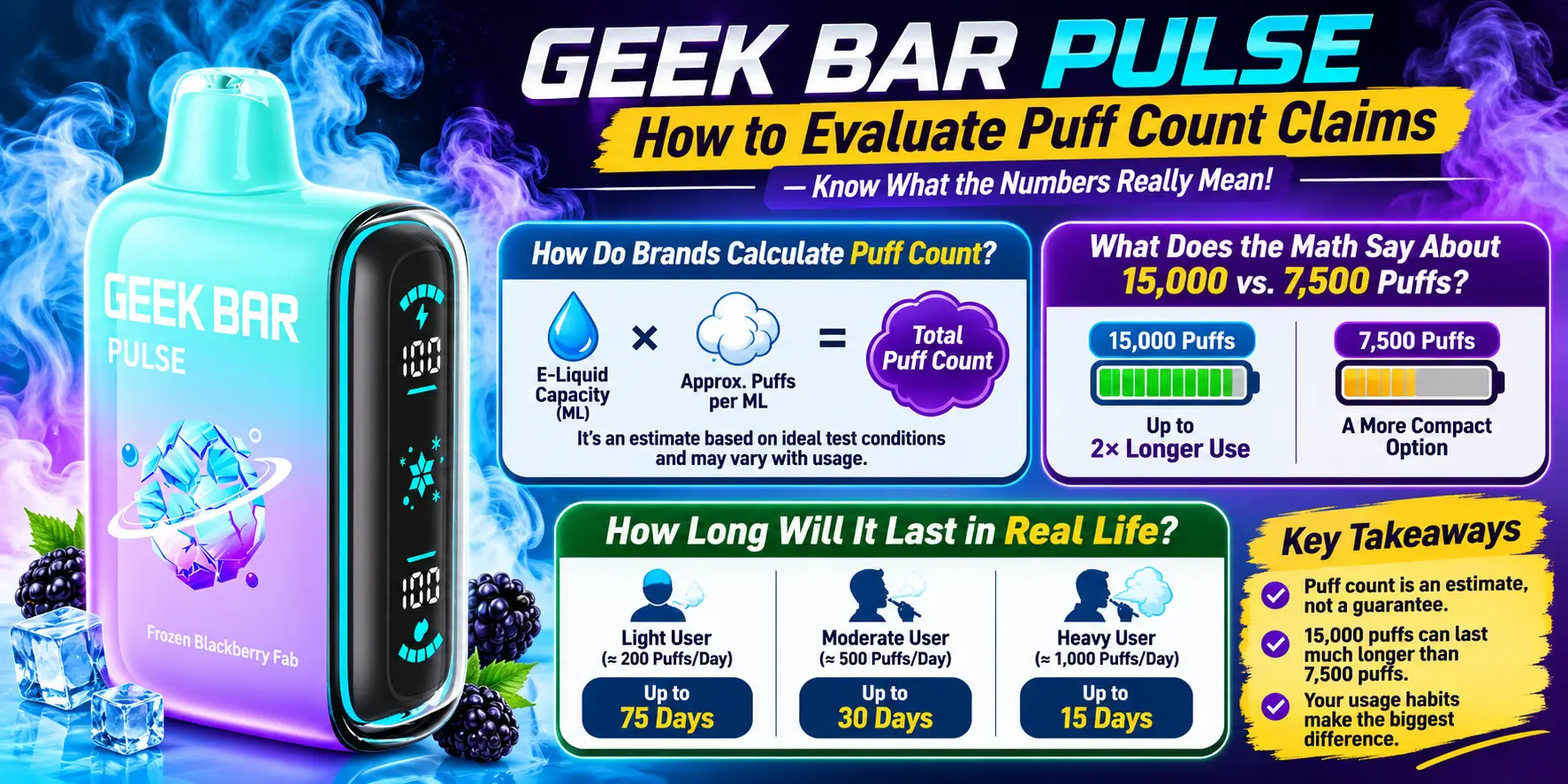
A puff count is the brand’s estimate of how many inhalations a device can deliver. It is not a measured guarantee. Treat 15,000 as the ceiling for Regular Mode and 7,500 as the ceiling for Pulse Mode.
Most puff estimates come from machine testing. A machine draws a fixed volume for a fixed time, again and again, until the device stops producing vapor. Real people do not puff like machines.
Standardized methods exist. ISO 20768:2018 and CORESTA Recommended Method No. 81 both describe how to run e-cigarette aerosol through a machine under set conditions. A brand can follow a method like these, adjust the settings, or use its own protocol. The printed number rarely tells you which.
Divide the 16 mL capacity by each puff claim. Regular Mode works out to about 0.00107 mL per puff, or roughly 1.07 mL per 1,000 puffs. Pulse Mode works out to about 0.0021 mL per puff, or roughly 2.13 mL per 1,000 puffs.
That tells you something useful. Pulse Mode claims about twice the liquid per puff, which fits a stronger, denser hit. The math does not prove either number. It shows the two claims agree with each other, which is more than some spec sheets manage.
Your habits decide the answer. At 200 puffs a day, 15,000 puffs lasts 75 days, and 7,500 puffs lasts about 38 days. Longer draws, chain sessions, and Pulse Mode all shorten that timeline.
Our guide to How Long Does Geek Bar Pulse Last? walks through real-world lifespan in detail. For the model-specific numbers, see the Geek Bar Pulse Puff Count breakdown. Treat every “up to” figure like the fuel economy sticker on a new car: a best-case reading, not a promise.
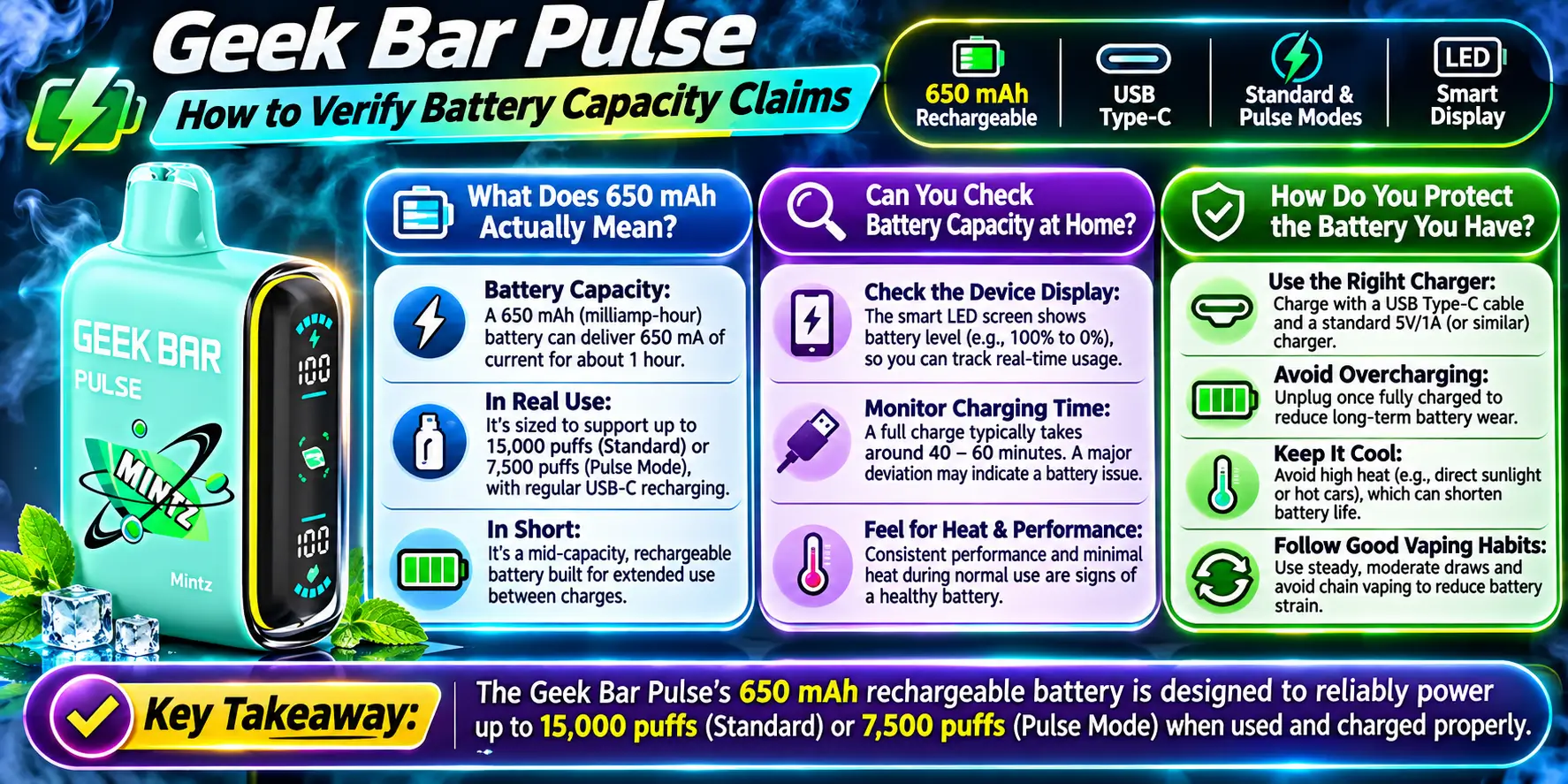
A battery rated at 650 mAh tells you how much charge the cell holds. It does not tell you how many puffs you get. Because the device recharges over USB Type-C, battery size limits each session, not the total lifespan.
The unit mAh stands for milliamp-hours. It measures how much current a battery can supply over time. A 650 mAh cell can deliver 650 milliamps for one hour, or a smaller current for longer.
To compare it with other devices, convert to watt-hours. A typical lithium cell runs around 3.7 volts, so 650 mAh equals roughly 2.4 watt-hours (0.65 Ah × 3.7 V). That is a fraction of what a modern smartphone carries, which is why you charge a vape more often than you might expect.
You can get a rough cross-check, not a lab result. Plug an inline USB power meter between the charger and the device, then charge from empty to full. The meter shows the energy delivered in watt-hours.
Expect a reading near the rating, usually a bit higher, because charging loses some energy as heat. A reading far below the rating deserves suspicion. A reading far above it suggests the device was not fully drained first.
Lithium batteries age faster in heat. Follow our Geek Bar Pulse Charging Instructions, avoid leaving the device on a charger overnight, and keep it out of hot cars. Our Geek Bar Pulse Storage Guide covers temperature and placement.
The FDA also publishes safety tips for avoiding vape battery explosions on its tobacco pages, and the advice applies here. If your device stops responding after a full charge, read Geek Bar Pulse Won’t Turn On before you assume the battery failed.
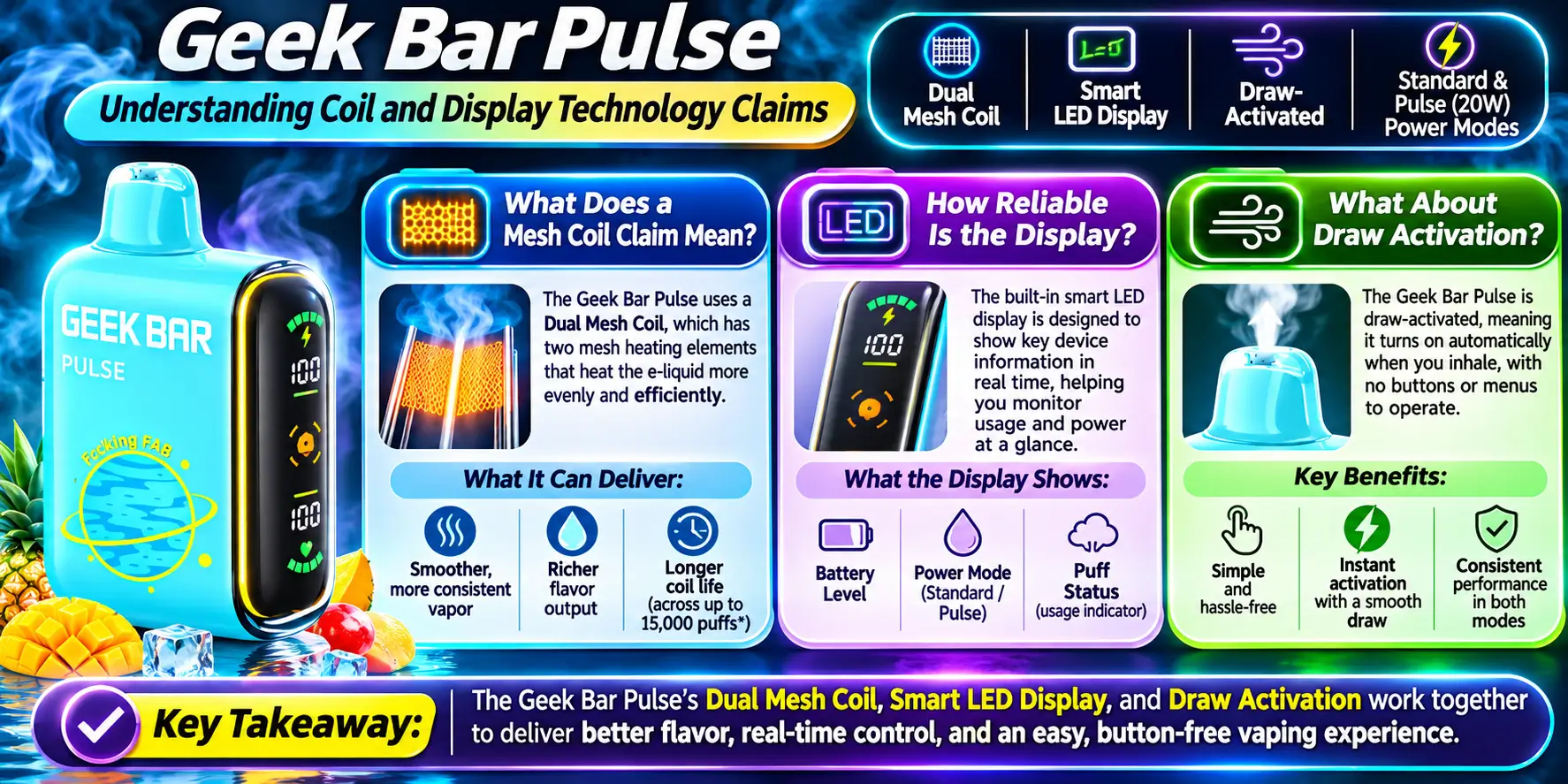
Coil and screen claims describe how the device heats liquid and reports its status. Both can improve your experience. Neither one is a measurement you can trust blindly, because both depend on how the brand designed the firmware and hardware.
A mesh coil is a flat metal grid that heats liquid across a wider surface than a wire wrap. Brands claim this gives more consistent flavor and vapor. Geek Bar markets the Pulse line with mesh coil technology.
You cannot inspect a sealed coil, so you judge it by performance. Watch whether flavor stays steady across the first, middle, and last third of the device. If output fades early, our Geek Bar Pulse Not Hitting guide explains the common causes.
A screen shows information. It does not independently verify it. Many displays estimate remaining liquid from usage patterns, since a tank sensor adds cost and complexity.
Treat the readout like a car’s fuel gauge near empty: a useful hint, not a precise number. Our Geek Bar Pulse Screen Explained guide breaks down what each icon and indicator means.
Draw activation means an airflow sensor starts the heating when you inhale. There is no button to press. This claim is easy to test: inhale and see whether the device responds, then hold it still and confirm it stays quiet.
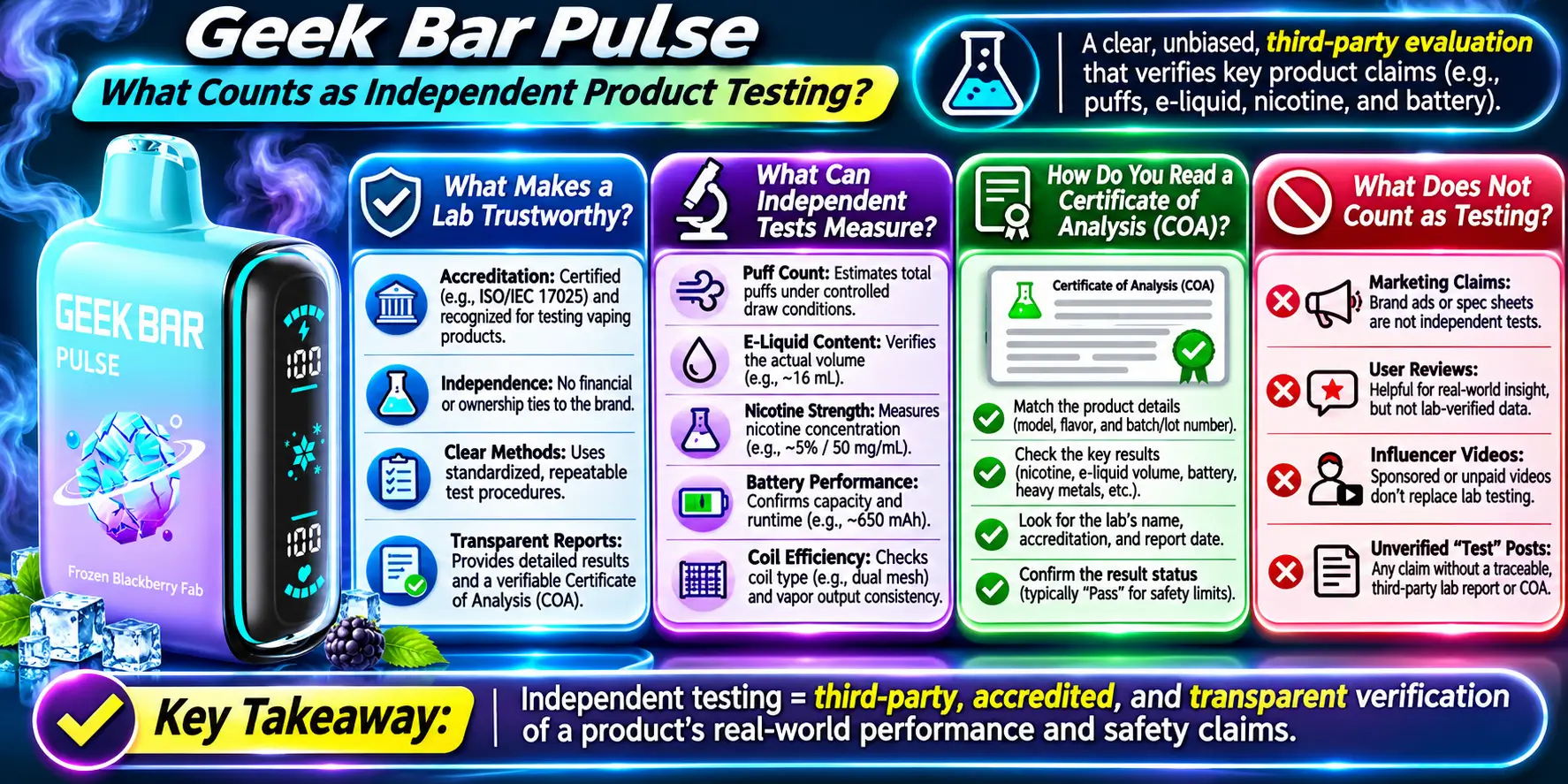
Independent testing comes from a third party with no financial stake in the result, using a written method, and publishing the findings. If any of those three pieces is missing, you have an opinion, not evidence.
Look for accreditation to ISO/IEC 17025, the international standard for testing and calibration laboratories. Accreditation shows the lab’s methods and equipment passed an outside review. It does not guarantee a favorable result, which is exactly the point.
A good lab report can confirm several of the claims in this guide:
A certificate of analysis, or COA, should list the lab name, accreditation, batch or lot number, test date, method, and units. A COA without a batch number is a decoration. Match the batch number to the one printed on your device.
A COA also does not protect you from fakes. A report for a genuine unit says nothing about a counterfeit one, so read Counterfeit Geek Bar Products before you trust any packaging.
Retailer reviews, unboxing videos, and “lasted forever” comments do not count. A five-star review measures enthusiasm, not puffs. The same goes for a brand-published “lab report” with no lab name, batch, or date.
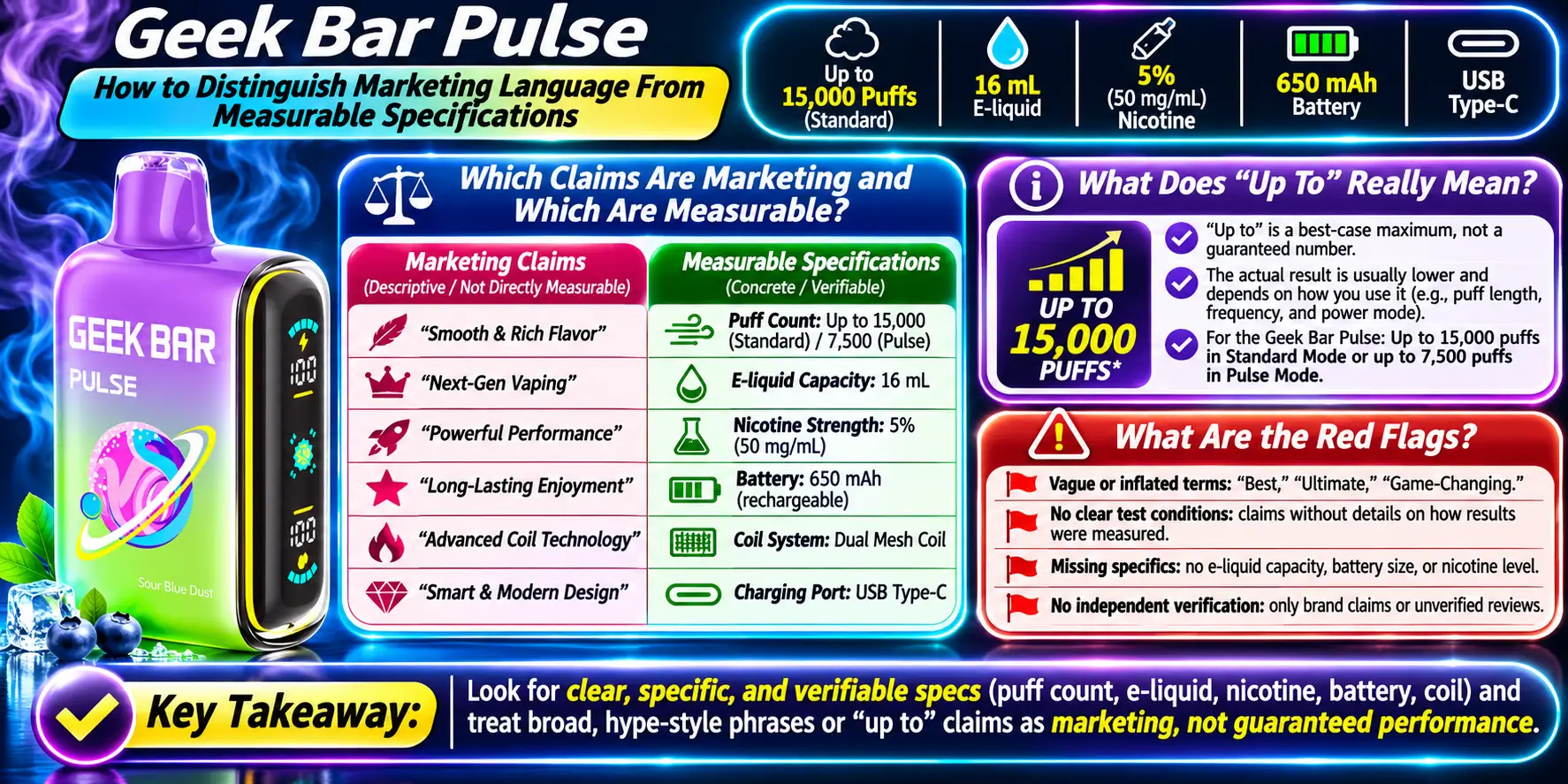
A measurable specification has a number, a unit, and a way to be proven wrong. Marketing language has adjectives. When a claim cannot lose an argument, it is marketing.
“Up to” marks the best case. A device rated for up to 15,000 puffs may deliver far fewer under your habits, and the claim stays technically true. Read the two words before you read the number.
Watch for claims with no units, no mode named, and no test conditions. Absolute promises like “guaranteed” or “never fails” should raise your guard. Real specifications come with limits.
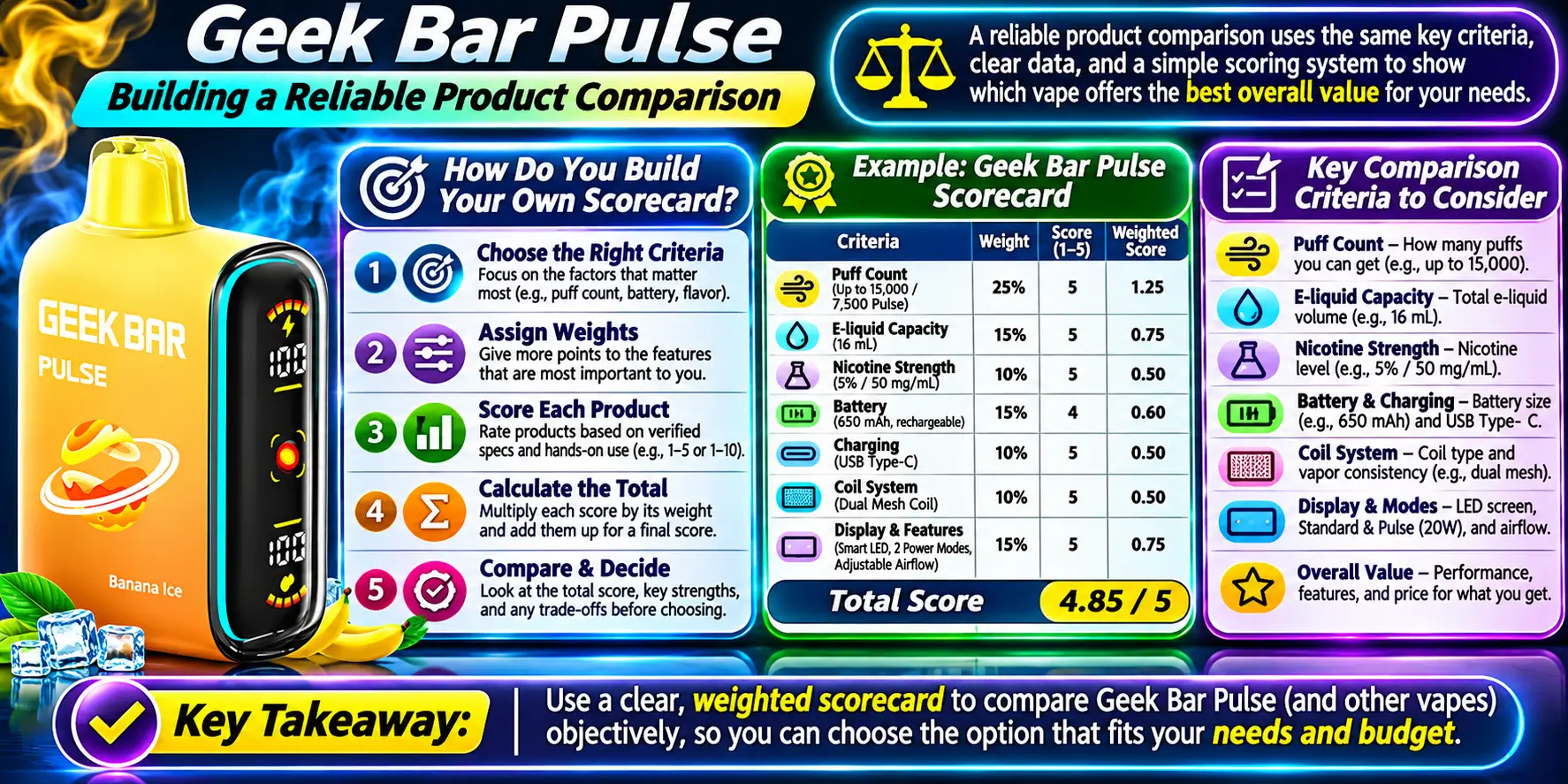
A reliable comparison lines up the same claims, in the same units, with an honest rating of the evidence behind each one. Start with the table below, then add your own rows for any device you compare.
| Claim | Stated Value | How to Check It | Evidence Strength |
|---|---|---|---|
| Prefilled Capacity | 16 mL | Read the label and packaging | High: printed and checkable |
| Battery Capacity | 650 mAh | USB power meter cross-check; lab test for certainty | Medium |
| Charging Port | USB Type-C | Inspect the port and charge it | High: you can see it |
| Operation | Draw-Activation | Inhale and observe | High: test it in seconds |
| Regular Mode Max Puffs | 15,000 | Independent machine testing | Low without a lab report |
| Pulse Mode Max Puffs | 7,500 | Independent machine testing | Low without a lab report |
| Nicotine | 5% | Batch-matched COA from an accredited lab | Low to Medium; a COA raises it |
One more fact belongs in your scorecard. At 5% nicotine, or 50 mg per mL, a full 16 mL device holds up to 800 mg of nicotine if the label is accurate. That is a lot of nicotine in one small package, which makes the nicotine claim the one worth verifying first.
1. What are Geek Bar Product Claims?
Geek Bar Product Claims are the specifications and performance statements the brand publishes about its devices, such as e-liquid capacity, battery size, puff count, and nicotine strength. Some you can confirm yourself, like the charging port. Others, like puff count, need independent testing before you can rely on them.
2. Is the 15,000 puff claim guaranteed?
No. The figure is a maximum under the brand’s own test conditions, and Pulse Mode lowers the ceiling to 7,500 puffs. Your real total depends on draw length, how often you puff, and which mode you use. Plan around a lower number than the printed one.
3. Does a 650 mAh battery limit how many puffs I get?
Not in total. A 650 mAh battery limits how long one charge lasts, but you can recharge through the USB Type-C port as often as needed. Total puffs depend mainly on the 16 mL of e-liquid, so the battery mostly affects how often you plug in.
4. How can I tell if a spec sheet counts as independent evidence?
Check who produced it. A spec sheet from the manufacturer, or copied by retailers, is a brand claim. Independent evidence comes from an accredited third-party lab, names the method, and lists the batch number. If you cannot match the report to your device, treat it as unverified.
5. Who can legally buy a Geek Bar product?
In the U.S., federal law sets the minimum age to buy any tobacco or vapor product at 21, and many states and retailers add their own ID checks. Separately, the FDA has stated that Geek Bar products are not authorized for sale, so check current regulations where you live.
WARNING: This product contains nicotine. Nicotine is an addictive chemical. 21+ users only.
If you want to see the full lineup after checking the specs, browse the Geek Bar Pulse Disposable collection (21+ only).
Geek Bar Pulse — Disposable Vape
🛒 Where to Buy Online
Choose from our verified partner stores — all carry 100% authentic Geek Bar Pulse products sourced directly from official US distributors.


Twelve Tribes
Wide Selection • Best Prices


Raven Route
Fast Delivery • All Flavors

Zippyzz
Quick Shipping • Great Deals
🔒 All partner stores are verified, age-gated, and ship only to legal US states. Purchases are made directly with the retailer — not geekbarpulse.com.
⚠️ Must be 21+ to purchase.